![]() | ||
|
But when was the last time you saw photo #143? Or #2,486? We’re all buried under a mountain of memories. You may have 10,000 MP3s, but stick iTunes on shuffle and you’ll hear stuff you haven’t heard in ages. Picture frame widgets for your Mac or PC are the photographic equivalent of iTunes shuffle. Just load up Picture Framer on Dashboard for your Mac, or Picture Frame on Yahoo! Widgets for your PC, and let the shuffling begin! Both offer a choice of slick frames and the ability to view your own pics, or even view pics from Flickr (your own, or your contacts.)
Photo Widgets for Your Mac or PC
www.photojojo.com/content/tips/photo-widgets/ p.s. The Deluxe version of Picture Framer for Mac normally costs $5, but Photojojo readers can get it for free today (8/21) only! Find out how. Published on August 21, 2006 — See more Tips
|
|
Enter the Phlash. While camera phone designers have been busy equipping most phones with a cheap sensor that performs poorly in low light and a flash that’s put to shame by a firefly, the Phlash was created solely to light your camera phone pics well. Simply hold down the Phlash button, compose your subject in its cool, white LED glow, and snap your pic. All camera phones work, and the batteries are replaceable. Designed to cast an even spread of light a meter away — up to 12x the power of your camera phone flash — you can stick the Phlash to the back of your phone (adhesive backing included) or use the tiny loop of thread to dangle it instead. Sticking the Phlash to your phone does add a bit of bulk, but if you use your camera phone frequently, it’s worth it to be able to shoot in the dark. The Camera Phone Phlash
Published on August 17, 2006 — See more Buy This
|
|
But wanna know the real reason your camera records video? It’s so you can enjoy a good laugh while making friends and loved ones look silly. You see, when you hold up a camera, people expect you to take a photograph, not a video. So flip your camera into video mode and pretend like you’re taking a photo. Feign technical difficulties while your bud tries patiently to hold his smile and you’re virtually guaranteed an amusing minute or so of strained footage. Don’t believe us? Check out comedian Katie Dippold’s collection at Long Awkward Pose. (Some favorites: Anthony, Deniz, Jack Jack — what a sport!) Life is too short and too serious not to play the occasional practical joke. And trust us, you’ll both laugh about it afterward. Long Awkward Pose
|
|
But whereas you can print a photo, stick it onto a cupcake, get it made into a sketch for $1, or turn it into a calendar, what’s a body to do with all those 30 second video snippets? Why, turn them into flipbooks, of course! FlipClips takes your short video clips and prints them into little flipbooks. Just go to their site, upload a clip, choose a title and cover design, and $9 and 10 days later, you’ve got yourself a custom-made, full-color flipbook. Sweet! FlipClips.com p.s. For a closer look, check out our jackrabbit-fast 40-second demo video. Published on August 10, 2006 — See more Buy This
|
|
Mix equal parts digital camera, computer, and imagination (you’ve got all three), and you’re on your way. Although flashier computer-generated animation is in vogue, stop-motion has a rich heritage of its own. After all, who doesn’t love the Gumby shorts of the 50s and 60s, Gumby’s comeback in the mid-90s (you know you’ve arrived when you’re a spokescharacter for the Library of Congress!), and the ever-popular Wallace and Gromit? And it’s not limited to claymation, either–Tim Burton used stop-motion and puppets to create The Nightmare Before Christmas, and Comedy Central’s Robot Chicken uses stop-motion with action figures and toy props. You can use just about anything in your stop-motion animation, and thanks to digital cameras and computers, creating one is now super easy.
Photojojo’s Stop-Motion Animation Tutorial
www.photojojo.com/content/tutorials/stop-motion-digital-camera/
|
|
Those ancient works of art took hundreds of hours of painstakingly precise labor. Larger works even employed teams of artisans. You don’t have teams of artisans. But you do have LEGOs. And Photoshop. John Tolva wrote up a tutorial that takes you step-by-step through the process of creating a photo mosaic using LEGO bricks. It’s not gonna turn your studio apartment into a villa, but we think it’ll bring a touch of class to the joint. Also worth a look: Holly Barhamand made a photo mosaic out of beads, the mathematics behind arranging differently shaped tiles can get quite complicated, and Ed Hall LEGO-fied Starry Night. It took several months and ten thousand bricks! John Tolva’s LEGO Photo Mosaic How-to
|
|
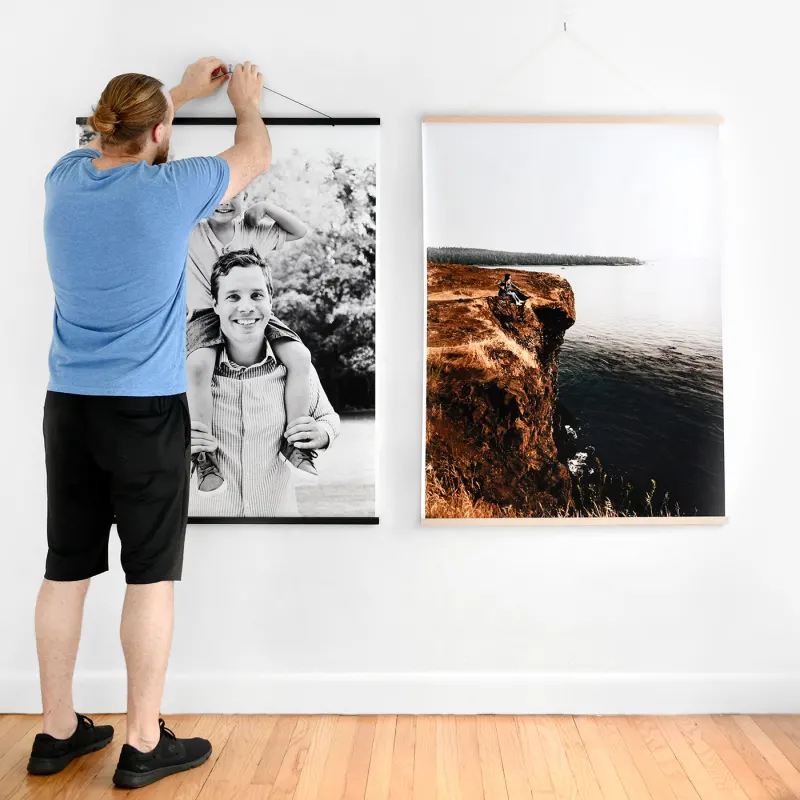
You see, we spend most of our time here at Photojojo World Headquarters (a.k.a. Amit’s bedroom) looking for awesome ways for you to show off your photos. As you can imagine, we run into a lot of photo frames. And most photo frames are really, really dull. So when we discovered this sleek and simple photo rope, this non-rectangular, non-photo frame, we were pretty stoked. When we found it was cheap, and used tiny, super-strong magnets to boot (we’re suckers for tiny magnets), we were sold. In fact, we liked it so much, we bought a bunch and put them up for sale. Magnets: miracle cure for backaches, headaches, and achingly boring photo frames. Photojojo’s Magnetic Photo Rope |
|
Our pal Josh, shown here holding his imaginary camera, has a nifty trick that will let you fix those shots in a jif. All you need is a copy of Photoshop (almost any version will do) and about five minutes. You can use his technique to improve nearly any photograph where extreme lighting fools your camera into underexposing your image. Watch our quick video to learn how to do it!
Photojojo’s Five Minute Photo Fix
www.photojojo.com/content/tutorials/five-minute-photo-fix/
|
|
But as you grew bigger, the pictures grew smaller. Eventually, words replaced them altogether. If the rise of the graphic novel is any indication, we still like our stories better with pictures. Here’s a fun project that marries our love of words and photography: Go through your photos and find an event with lots of shots (your friends hanging out, a party, a vacation, whatever.) Now pick five photos, give or take, that tell a story when put in sequence. Ideally, it should make sense without any words. Your story may be true or made up, silly or serious. The point is to look at your photos as narrative building blocks. To put a new spin on it, next time you’re out with your camera, consider how the photos you’re shooting would look in sequence. Or start with a plot and take the photos necessary to illustrate it. For inspiration, check out Isuru’s Moon Day Massacre or this story of Homeland Security told using stormtroopers and care bears. Flickr Visual Storytelling Group Published on July 24, 2006 — See more Photo Projects
|
|
Behold, the Blender Pen. It won’t exactly let you cram a backpack into your inkjet, but it’s close enough. Thanks to the miracle of modern science, and powerful-yet-safe-if-used-correctly solvents, all you need for quick-and-dirty photo transfers is a photocopy of your image and a $4 blender pen. A blender pen transfer works great on all kinds of fabrics, tile, paper, wood, copper, linoleum, and a variety of other materials. And it won’t leave that plastic texture that old inkjet transfers sometimes did. Check out the moleskin notebooks, fabric pouches, and quilts people have personalized with this purty pen. Cheap, fun, and easy–our favorite words. How to Make Photo Transfers with Blender Pens p.s. Get your (clear) blender pen at a local art supply store or order it online. (If they sell out, try these guys.) |
Made on Omicron Persei VIII. Designed on Earth. © Photojojo